


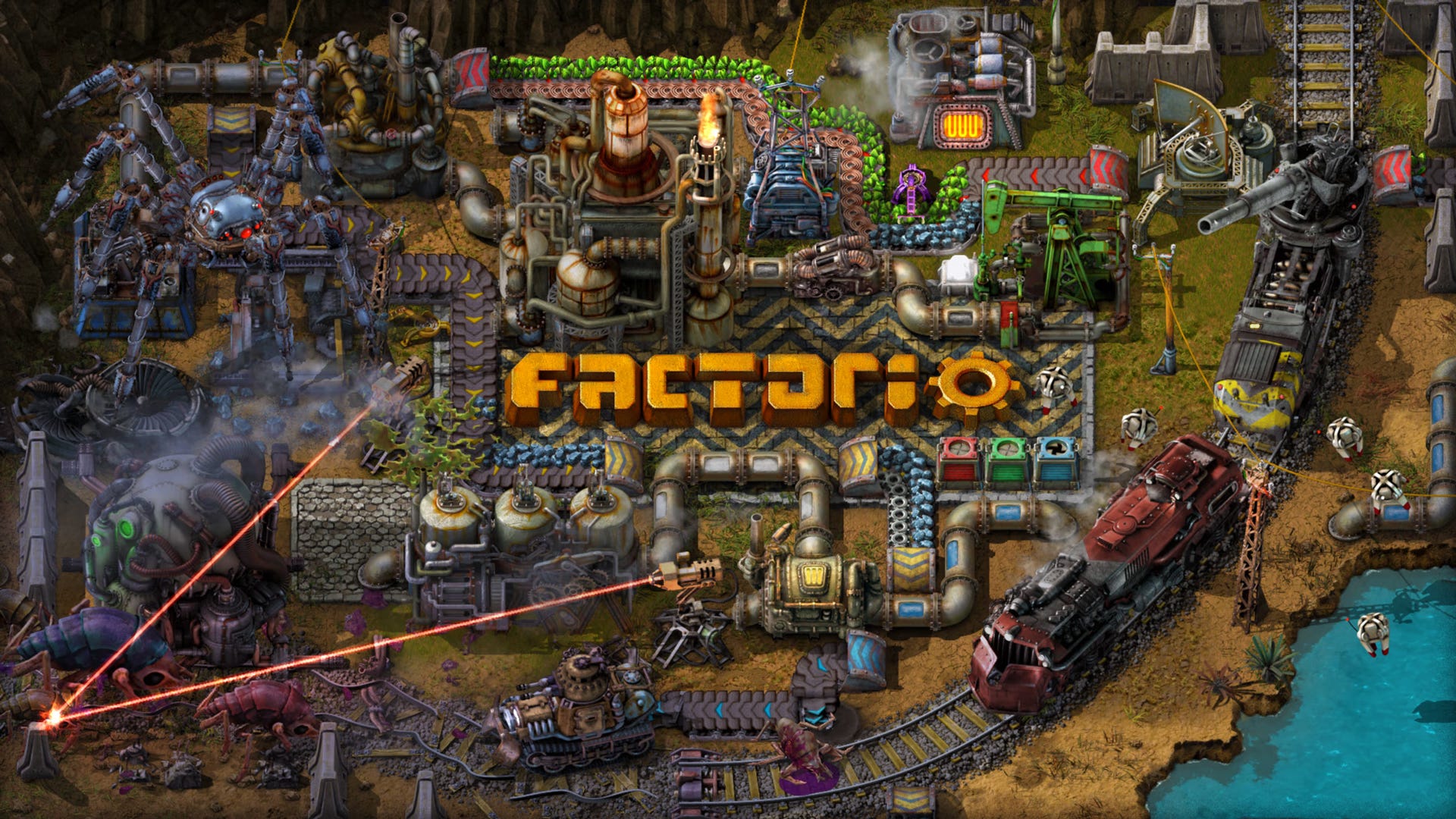
Factorio is a cult hit, a perennial seller, one of those games that at least one person you know is seemingly always playing.
The game is about building factories. Or, really, you grow them, slapping down component parts like conveyor belts, mining equipment, and other simple machines. The parts slowly compound and your machine evolves gradually into a massive resource extraction system that spans first acres, then square miles.
The complexity that emerges from this straightforward premise is dizzying. Observing a skilled Factorio player at work feels less like watching a videogame and more like taking on the perspective of God, serenely overseeing humanity’s industrial terraformation of the earth.
And indeed, the ultimate goal in Factorio is to proceed through several industrial revolutions of your own creation, ultimately gathering enough resources and building enough manufacturing capacity to construct a rocket powerful enough to leave the planet behind and usher the player-character into the space age.
Factorio has always been a favorite of engineering types: the type of person who might otherwise tinker with a model train set, or an elaborate excel model, or a python script. Nerds, is what I’m saying.
More recently, though, I’ve been noticing more and more references to Factorio coming from a very specific subset of engineering types: software engineers who are obsessed with AI-powered coding systems like Claude Code. The specific claim I keep seeing thrown around is that Factorio works as a sort of bicycle for the mind to prepare people for using AI agents more effectively. Learn to play Factorio, learn to harness the tools of the future—so it’s said, anyway.


It struck me that Factorio is probably the one game that most seriously explores the concept of automation. The question of how to automate one’s own labor is the central challenge posed by the game, and so I wondered what its creators might think about the viral claims going around that Factorio itself is useful as a tool for training people to use real-world automation tools.
Luckily, Michal Kovařík, Founder and Company Director at Factorio developer Wube Software, was kind enough to respond to my questions over email.
Kovařík and the rest of the Wube team are based in Prague, in the Czech Republic. What follows is our exchange, with very minor edits for formatting.
PUSH TO TALK: One of the biggest questions facing humanity in the 21st century is the role of automation. What ought we hand over to the machines, and what work should we save for ourselves? What's your view on this? And does Factorio shed light on this question?
Michal Kovařík: Well, it certainly shows that, in principle, automation is nearly limitless leverage of human work, which is mostly visible with one human and endless factories. Factorio is the optimistic fantasy, that the human is always in control till the end. There was always some kind of idea that the player would automate even simple tasks, like expanding mines etc, which would be done by some kind of "AI assistant" which would eventually escalate into the factory rejecting the player as being not needed anymore. But it sounds too grim honestly.
More recently I've seen people arguing that Factorio is a good way to train computer engineers in using AI agents. What do you make of this? Are you yourself Claude Coding?
I had my first experience with AI help for coding two months back, when I was doing a small side project in technologies which aren't my main focus (web stuff). I've learned that for that case, AI is a great help to answer questions like: "how to write this function this and this way,” or "how to write this weird sql command I need," or: "rewrite this forloop using a lambda, I know there is something in this language," etc.
But I don't really have much experience with AI being used to actually generate code in bigger chunks than small snippets of code that I just put together. The little experience I had with it was enough to not let it anywhere near this task for now.
It might be certainly fun to see how the agents are improving etc. Somehow, I believe that the easiest way to train AI these days is to get a physical robot, and train it on simple tasks in the real world.
One could easily imagine Factorio with other input methods or control schemes—RTS style command of many small units for construction or even a Sim City style Godlike view of the world. What led your team to settle on a single controllable human entity as the default interface layer for factories in Factorio? Building on this, given the remote view tools and automation abilities you unlock as the game progresses, it almost feels like the game unlocks RTS-style control as a reward for mastering its available tools... would you agree with that characterization?
Having character instead of god view helps with few things.
1. It makes it more personal, where your avatar is right there. It also means you are personally reachable and can fight.
2. It makes the progression into automated construction robots, spidertrons and general shift of god view controlling more rewarding compared to having it basically from start. And progression is very important in my game design philosophy.
In the base version of Factorio, achieving space travel is the ultimate goal for the player. And then the Space Age expansion treats reaching the edge of the solar system as the end goal. What does the dream of space travel mean to you?
When I get asked what is my wish, I say I would like to live 4 billion years. For many reasons, but one of them would be to have a chance to witness humanity reach the stars.
Are there aspects of the real world that you wish worked more like they do in Factorio?
The main character didn't have to pay subscription for his stuff to continue working. He actually owned these.

Interesting Links from January
A few things that grabbed my attention this month:
Moby-Dick Discord Edition - I have Claude Code on the brain, obviously, and used it to create a Discord bot that published the entire text of Moby-Dick as a Discord server. Each chapter is a channel, and each paragraph is a message. About 160 people have since joined the server and are spamming emoji reactions on their favorite parts of the book. This is, I’m sure we can all agree, what Herman Melville would have wanted.
Genie 3 - I think world models are among the strangest and potentially most interesting nascent technologies of the moment. Google DeepMind’s new public release of Genie 3 suggests the tech is advancing faster than expected.
 Google DeepMind@GoogleDeepMindStep inside Project Genie: our experimental research prototype that lets you create, edit, and explore virtual worlds. 🌎5:01 PM · Jan 29, 2026 · 6.35M Views663 Replies · 3.03K Reposts · 24.2K Likes
Some hope for independent games media - There are signs that the paid subscription model is working for a small but growing set of writers and creatives who cover games. Stephen Totilo’s very transparent breakdown of the revenue growth for Game File is one encouraging signal. The successful launch of Mothership—a women-focused publication from former Polygon editors Maddy Myers and Zoë Hannah—is another win for a segment of media that has had precious few Ws in recent years.
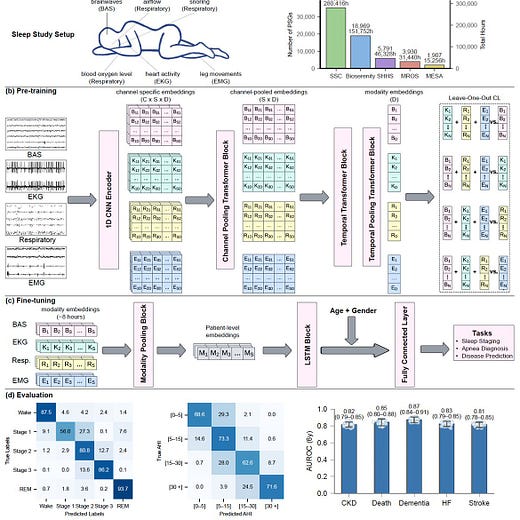
Disease prediction based on sleep patterns - Another AI breakthrough: A paper in Nature found that over 130 diseases can be predicted via data gathered over the course of just one night of sleep. Per the report: “the model showed strong predictive performance for several cancers: prostate cancer… breast cancer… and melanomas of skin.”
 James Zou@james_y_zouToday in @NatureMedicine we report that AI can predict 130 diseases from 1 night of sleep🛌 We trained a foundation model (#SleepFM) on 585K hours of sleep recordings from 65K people—brain, heart, muscle & breathing signals combined. AI learns the language of sleep🧵
 4:29 PM · Jan 6, 2026 · 896K Views281 Replies · 2.09K Reposts · 11.1K Likes




Movie Recommendation: Train Dreams - There’s a huge amount of buzz around this movie, which earned at Best Picture nomination at the Oscars. I physically couldn’t speak for about five minutes after the film ended. You can watch it on Netflix.

That’s all for now. I’ll be back with another roundup next month.
You’re back?! Monthly now?
It is really good news to see gaming journos kicking goals with their own platforms. Where they own their work, audience and income.
I often wonder about over saturation of gaming journalism platforms to sub to, then I remember the internet is a big place.
I’ll have to check in on them later this year, but I hope SkillUp’s This Week In Videogames is among those seeing success too. They hit 550 paid subs at $10 USD per month in their first month.
It’s me, the friend who’s always playing factorio